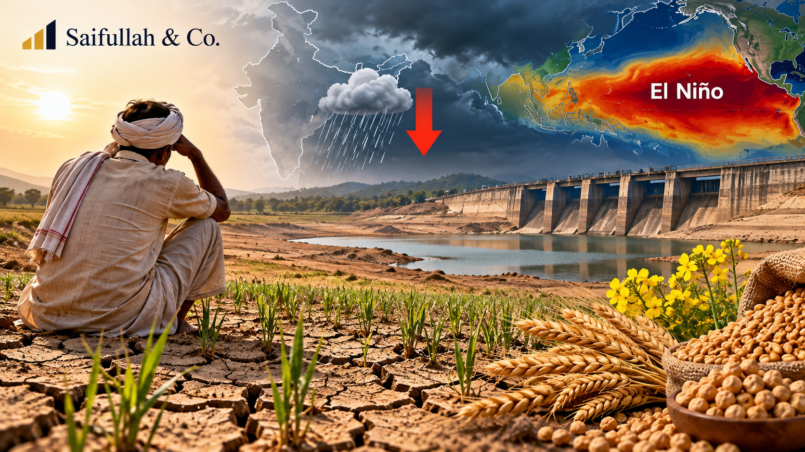
India’s agricultural sector is approaching a crucial test as farmers prepare for the 2026–27 Rabi season. A deficient southwest monsoon has left concerns over water availability, reservoir storage and the ability of farmers to irrigate winter crops. With El Niño conditions adding uncertainty to the weather outlook, the consequences could extend beyond agriculture to rural incomes, food prices and economic growth.
According to the India Meteorological Department (IMD), the 2026 southwest monsoon ended with rainfall at approximately 87% of the long-period average (LPA), making it the weakest monsoon since 2015. The country received around 759.4 mm of rainfall against a normal of approximately 868.6 mm between June and September.
The shortfall was particularly pronounced in southern and eastern India, where seasonal rainfall reached around 76% and 74% of the LPA, respectively. These regional differences matter because agricultural losses depend not only on national rainfall totals but also on where rain falls, when it arrives and how much water is available for irrigation.
Source: Business Standard — 2026 monsoon ends with nearly 13% rainfall deficit
Why a weak monsoon threatens the Rabi season
India’s agricultural calendar is divided broadly into Kharif and Rabi seasons. Kharif crops are generally grown during the monsoon, while Rabi crops are sown after the rainy season and harvested during the following spring.
Wheat, mustard, chickpea and several other winter crops depend on adequate soil moisture and, in many regions, irrigation. Although Rabi crops do not rely on the southwest monsoon in the same way as Kharif crops, the monsoon replenishes reservoirs, supports groundwater recharge and leaves moisture in agricultural soils.
When rainfall is deficient, these water reserves may be insufficient to meet irrigation demand during the winter growing season. Farmers who depend on canals, reservoirs or groundwater could therefore face greater difficulty maintaining adequate moisture during sowing and crop development.
The impact will not be uniform. Farmers with reliable irrigation infrastructure may be better protected than those cultivating rain-fed land or relying on depleted local water sources.
Reservoir storage emerges as a major concern
The problem is not limited to rainfall. The amount of water retained in reservoirs after the monsoon can influence how much irrigation is available in the months that follow.
In its October 1, 2026 assessment, credit-rating agency ICRA warned that below-average reservoir storage could weigh on Rabi sowing and output. The concern was particularly significant in southern India, where reservoir storage was 24 percentage points below its historical average at the end of September.
ICRA also highlighted the potential implications for agricultural growth and rural demand. It reduced its forecast for growth in agriculture, forestry and fishing gross value added (GVA) in FY2027 to approximately 1%, from its earlier forecast of 1.3%.
These estimates are forecasts, not confirmation that Rabi production will decline by a specific amount. The eventual outcome will depend on sowing decisions, irrigation availability, subsequent rainfall and crop-growing conditions.
Source: ICRA — Sub-par monsoon and low reservoir storage to weigh on Rabi sowing
How El Niño increases the uncertainty
El Niño is a climate phenomenon involving warmer-than-average sea surface temperatures in parts of the equatorial Pacific Ocean. It can alter atmospheric circulation and is associated with an increased risk of below-normal rainfall during India’s southwest monsoon.
The IMD has explained that El Niño’s influence varies between events. Of the 16 El Niño years recorded since 1950, seven were associated with below-normal Indian monsoon rainfall. This illustrates why El Niño should be treated as a risk factor rather than a guarantee of drought.
In 2026, the monsoon season coincided with developing El Niño conditions and a substantial rainfall deficit. The combination increased pressure on rain-fed agriculture and water resources.
However, the effect on Rabi crops will depend on the water deficit already accumulated, future weather patterns and the availability of irrigation. El Niño alone cannot establish how much wheat, mustard or chickpea production will be lost.
Source: Press Information Bureau — Government statement on El Niño and the Indian monsoon
Four ways farmers could be affected
1. Higher irrigation costs
When surface water supplies are inadequate, farmers may need to pump groundwater more frequently. This can increase electricity or diesel expenses and put additional pressure on already constrained water resources.
2. Delayed sowing or reduced acreage
Farmers who cannot secure sufficient water may delay planting, change crops or reduce the area cultivated. These decisions can affect total production even before any crop damage becomes visible.
3. Lower yields
Moisture stress during germination and critical stages of crop development can affect plant growth and yield. The severity depends on the crop, soil conditions, irrigation access and weather during the growing season.
4. Pressure on farm incomes
If cultivation costs rise while yields or marketable output decline, farmers’ margins could narrow. The effect would be particularly important for households with limited savings or substantial outstanding agricultural loans.
Could food inflation rise?
A difficult Rabi season could also influence India’s food-price outlook, particularly if production of important cereals or pulses falls short of demand.
However, weaker rainfall does not automatically translate into higher retail prices. The final impact will depend on actual production, government procurement, public stocks, imports, market arrivals and policy responses.
Food-processing companies and other businesses that depend on agricultural commodities may also face higher procurement costs if supplies tighten. These pressures can affect operating margins before they are passed on to consumers.
A weak monsoon could add pressure to food prices if it results in lower crop production. Separately, ICRA expects rural CPI inflation to remain elevated amid West Asia-related price pressures and firming domestic food prices. The report warns that continued pressure on real rural wages could weigh on rural demand in the second half of FY2027.
Source: ICRA — Monsoon, crop output and food-inflation risks
What should investors and policymakers monitor?
The next few months will be important for determining whether India’s water deficit translates into weaker winter crop production.
Investors should track Rabi sowing figures, regional reservoir storage, irrigation conditions, crop-specific production estimates and wholesale prices for wheat, mustard and pulses. Rural-facing businesses may also need to monitor signs of weaker farm incomes and changes in demand.
For policymakers, the priorities include efficient water allocation, support for vulnerable farmers, timely agricultural advisories and measures that improve water-use efficiency.
Conclusion
India’s weak 2026 monsoon has created a difficult starting point for the Rabi season. Lower reservoir storage, uneven rainfall and El Niño-related uncertainty have increased the risk of reduced sowing, higher irrigation costs and pressure on crop yields.
Yet the scale of any damage remains uncertain. Adequate irrigation, favourable weather during the winter season and changes in crop choices could limit the impact.
The key question is no longer simply how much rain India received during the monsoon. It is whether the water remaining after the rainy season will be sufficient to sustain winter cultivation. The answer will help determine the outlook for farm incomes, rural consumption and food-price stability in the months ahead.
