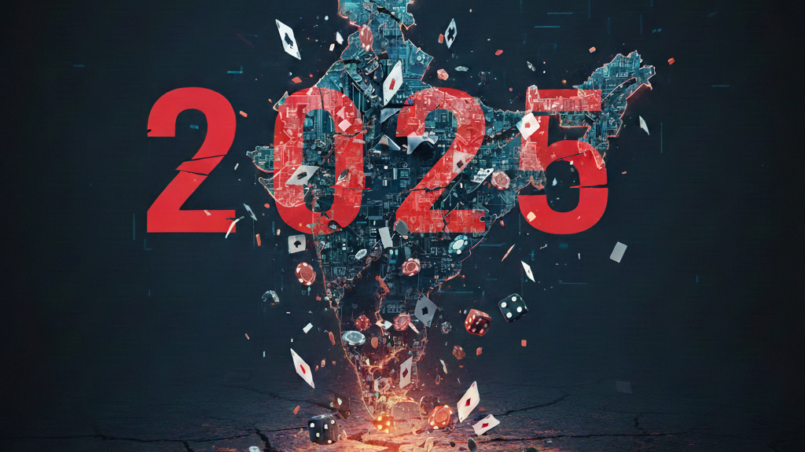
Regulation, shutdowns, and industry upheaval — what comes next for gaming, jobs and innovation.
The End of an Era: India’s Real-Money Gaming Sector in 2025
In a dramatic turn of events, 2025 will be remembered as the year India’s real-money gaming (RMG) ecosystem unraveled. What once stood as one of the fastest-growing digital entertainment sectors in the country — valued at billions and employing hundreds of thousands — has now been forced into a sharp contraction following decisive regulatory action.
From Growth to Regulatory Reset
For much of the last decade, online gaming platforms offering cash-based contests — including fantasy sports, poker, and skill-based games — enjoyed explosive growth. Startups attracted venture capital, recruited large teams, and built vibrant communities of players across India.
That trajectory changed abruptly in August 2025 when Parliament passed the Promotion and Regulation of Online Gaming Act, 2025. Under this law, games that involve real money — where users deposit funds to compete for cash — were effectively prohibited nationwide.
The law’s intent was broad: protect consumers from financial harm, crack down on illegal betting, and bring legal clarity to a space previously governed by a fragmented mix of state rules and court decisions. But the practical consequence was a near-total shutdown of the real-money segment.
Shockwaves Through the Industry
In the weeks after the legislation came into force:
- Major platforms including Dream11, WinZO, and Mobile Premier League (MPL) paused or shut down cash-based games, erasing the core revenue stream of many operators.
- Some companies announced large layoffs and restructuring efforts as user engagement dropped sharply.
- Other firms halted operations entirely or scaled back to free-to-play formats only.
Industry leaders estimate that over 200,000 jobs and billions of dollars in value creation are now in jeopardy, with both domestic and foreign investors reassessing their bets in the segment.
The Government’s Rationale
The government has defended the ban as a necessary intervention. Officials and policy framers argued that unregulated money gaming posed risks such as addiction, financial loss for households, and the proliferation of offshore betting platforms that avoid Indian law and tax regimes.
By distinguishing between permissible games of skill (such as e-sports and purely recreational gaming) and those involving monetary stakes, the law aims to promote safer, regulated gaming while eliminating activities the state views as harmful.
Industry Response and Legal Pushback
Unsurprisingly, many gaming companies and industry bodies have voiced strong objections. They contend that:
- The law’s broad language lumps skill-based games in with chance-based gambling.
- The shutdown drives players toward unregulated offshore platforms that operate with little oversight.
- The ban imperils innovation and entrepreneurial growth within India’s digital economy.
Some platforms are reported to be exploring legal challenges and appeals to higher courts, arguing that the legislative process did not sufficiently consult stakeholders before implementation.
What’s Next for Players and Entrepreneurs?
With the real-money model largely sidelined, the sector’s future now hinges on several possible developments:
- Regulatory Fine-Tuning:
Lawmakers could revisit provisions to carve out clearer definitions or frameworks for regulated RMG, balancing consumer protection with business viability. - Shift to Skill-Only and Free-Play Models:
Gaming platforms may pivot toward formats that do not involve monetary competition, leaning into advertising, subscriptions, or esports sponsorships. - Growth in E-Sports & Social Gaming:
The law retains space for purely skill-based and social games, which could become the next frontier of investment and user engagement. - Judicial Review:
Court rulings on challenges to the RMG ban may reshape the sector — potentially restoring some forms of cash-based gaming under tighter controls.
Conclusion: A New Chapter
What happened in 2025 was more than a regulatory adjustment — it was a reset of India’s online gaming landscape. The sudden collapse of the real-money segment has left startups, users, and policymakers reassessing assumptions about digital entertainment, economic opportunity, and consumer risks.
Whether this marks the beginning of a stronger, safer gaming industry — or simply displaces players and capital to unregulated spaces — remains one of India’s most debated tech-policy questions heading into 2026.
