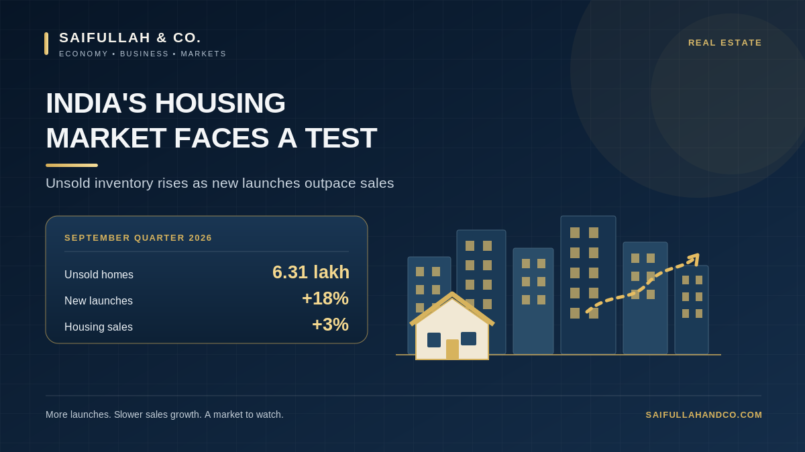
India’s residential real estate market is entering an important phase. Housing sales continue to grow, but new property launches are increasing at a much faster pace, adding to the number of unsold homes across major cities. With property prices remaining elevated, developers face a crucial question: can buyer demand keep up with the supply entering the market?
According to housing-market data from ANAROCK Research reported by Moneycontrol on October 12, 2026, unsold residential inventory across India’s seven major cities increased by 12% year-on-year to approximately 6.31 lakh units in the September quarter. Housing sales rose by 3% to 1,00,220 units, while new launches increased by around 18% to approximately 1.14 lakh units.
These figures reveal a growing imbalance between the pace at which developers introduce homes and the speed at which buyers purchase them.
Sales Are Growing, but Supply Is Growing Faster
The increase in housing sales indicates that demand has not disappeared. However, the considerably faster growth in new launches raises questions about whether the market can absorb the additional supply.
When developers launch projects faster than homes are sold, unsold inventory can accumulate. If this trend continues, companies may need to offer incentives, adjust future launches or wait longer to recover their investments.
Nevertheless, rising inventory alone does not signal an imminent property-market crash. The impact depends on where the unsold homes are located, their prices, their construction status and the financial position of the developers holding them.
Affordability Could Become a Bigger Concern
Property prices remain an important part of the equation. The reported data indicates that average residential property prices across the seven major cities increased by approximately 7% year-on-year, while the National Capital Region recorded growth of around 12%.
Higher prices can support developers’ revenue and asset values, but they may also make homeownership increasingly difficult for buyers whose incomes are not growing at a similar pace.
The composition of new housing supply raises another question. Homes priced between ₹80 lakh and ₹1.5 crore accounted for approximately 34% of new launches, while properties priced below ₹40 lakh represented only 14%.
This distribution suggests that buyers seeking lower-priced homes may have fewer new options available. However, launch figures alone cannot establish whether affordable housing demand is being underserved; sales, existing inventory and local income data must also be examined.
Housing Trends Differ Across Cities
India’s property market is not moving in one direction everywhere.
The reported figures show that housing sales in Hyderabad increased by 15% year-on-year, while Bengaluru recorded growth of 12%. The Mumbai Metropolitan Region registered a more modest increase of 5%.
Such differences demonstrate why national inventory figures should be interpreted carefully. A city experiencing strong demand may absorb new supply more effectively than a market where launches are outpacing purchases.
For developers, the critical indicators include sales velocity, unsold stock and inventory overhang—the estimated time required to sell available homes at the prevailing sales rate. A rising overhang can indicate that developers need to reassess their launch schedules or pricing strategies.
Could Higher Borrowing Costs Affect Buyers?
Financing conditions may add another layer of uncertainty. The Reserve Bank of India’s reported 25-basis-point repo-rate increase could affect home-loan costs if lenders pass the change on to borrowers.
The impact will vary according to individual loan terms and lenders’ decisions. Even a modest increase in borrowing costs can influence affordability for buyers who rely heavily on mortgages, particularly when property prices are already high.
However, interest rates are only one factor influencing housing demand. Employment, household income, consumer confidence and expectations about future property prices also affect purchasing decisions.
What Should Investors Watch Next?
For listed real estate companies, rising industry-wide inventory does not automatically translate into weaker financial performance. Investors should examine individual developers’ pre-sales, project launches, debt, cash flows and unsold stock rather than relying solely on national market statistics.
Companies with strong balance sheets and projects in high-demand locations may be better positioned to manage slower sales. Developers carrying substantial debt or relying on rapid property sales to fund expansion could face greater pressure if inventory continues to accumulate.
The coming quarters will help establish whether sales growth catches up with new supply or the gap widens further.
Conclusion
India’s housing market is showing both resilience and potential vulnerabilities. Sales are increasing, but new launches are growing much faster, while rising property prices create additional affordability challenges.
The key question is not simply how many homes developers are building. It is whether those homes match buyers’ budgets and whether demand can absorb them without prolonged increases in unsold inventory.
For homebuyers, investors and developers alike, the relationship between affordability, sales momentum and new supply may prove more important than headline price growth alone.
Source: ANAROCK Research data reported by Moneycontrol, October 12, 2026.
Disclaimer: This article is for informational and educational purposes only and does not constitute investment advice.

